
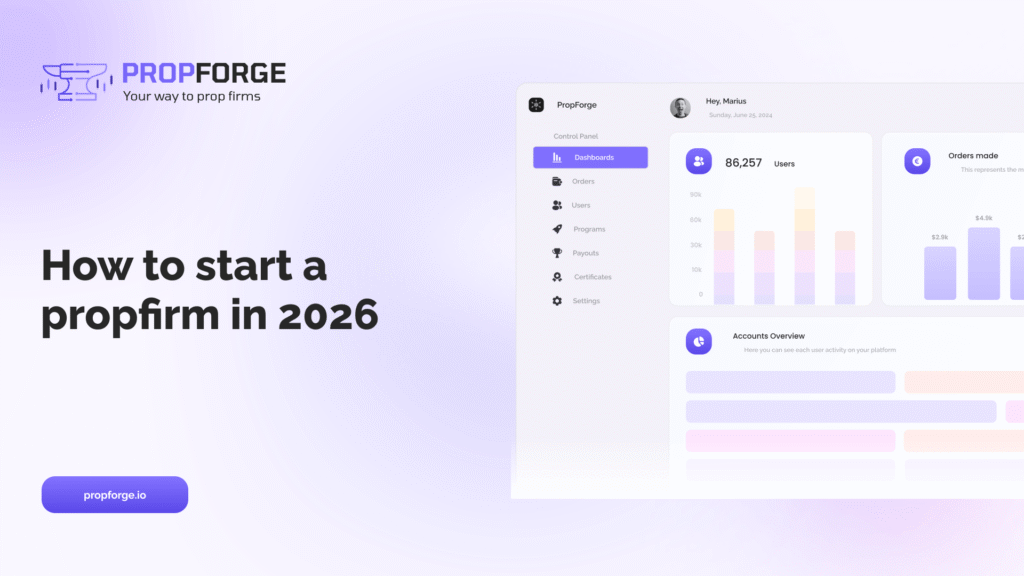
The proprietary trading industry has exploded over the past few years. Online prop firms now attract hundreds of thousands of traders worldwide who are looking for funded trading accounts and profit-sharing opportunities.
At the same time, many entrepreneurs are discovering that launching a proprietary trading firm can be an extremely profitable business model.
However, starting a prop firm is far more complex than it appears. Behind every successful prop firm there is a sophisticated technology stack that includes trading platform integrations, risk management systems, trader dashboards, payment processing, and evaluation programs.
If you are planning to start a prop firm in 2026, this guide will walk you through everything you need to know — from defining your business model to building the infrastructure required to operate a successful prop trading platform.
Why the Prop Firm Industry Is Growing So Fast
The growth of the prop trading industry is driven by several factors.
First, retail trading participation has increased dramatically over the past decade. More traders are looking for opportunities to trade larger capital without risking their own funds.
Second, the evaluation challenge model has proven to be a highly scalable business structure for prop firms. Traders pay a fee to participate in evaluation programs, and those who pass gain access to funded trading accounts.
Finally, improvements in trading technology have made it possible to operate global prop firms entirely online. Platforms can now manage thousands of traders simultaneously while monitoring risk and enforcing trading rules automatically.
Because of these developments, many entrepreneurs are exploring how to launch their own prop trading firm.
Step 1: Define Your Prop Firm Business Model
Before building the infrastructure, you need to define the type of prop firm you want to operate.
Most modern prop firms use one of the following models.
Evaluation Challenge Model
This is the most common model used by online prop firms.
Traders pay an entry fee to participate in an evaluation challenge designed to test their trading ability. If they reach the profit target while respecting drawdown rules, they receive access to a funded account.
This model generates revenue primarily from challenge participation fees.
Instant Funding Model
Some prop firms offer traders immediate access to funded accounts without a challenge phase.
These programs usually involve higher upfront costs and stricter risk management rules.
Hybrid Models
Many firms combine evaluation challenges with additional services such as educational programs, trading communities, or subscription-based platforms.
Choosing the right model depends on your target market and long-term strategy.
Step 2: Choose the Right Trading Platform
Every prop firm relies on trading platforms where traders execute their trades.
The most widely used platforms include:
-
- MetaTrader 4 (MT4)
-
- MetaTrader 5 (MT5)
-
- TradeLocker
-
- MatchTrader
-
- cTrader
Each platform has different strengths, broker integrations, and technological requirements.
When selecting a trading platform, you must consider:
-
- broker liquidity connections
-
- data feed stability
-
- integration capabilities
-
- cost structure
The trading platform is the core environment where traders interact with your prop firm.
Step 3: Build the Technology Infrastructure
This is where most aspiring prop firm founders underestimate the complexity.
To operate a professional prop trading platform, you need infrastructure that includes:
-
- trader dashboards
-
- account management systems
-
- challenge tracking
-
- risk monitoring
-
- payout management
-
- KYC verification
-
- analytics and reporting
Building all of this from scratch can take 12–24 months of development and require a large engineering team.
Because of this, many founders choose to launch using a white label prop firm platform rather than developing custom software.
A white label solution provides the entire infrastructure required to operate a prop firm while allowing you to focus on branding, marketing, and trader acquisition.
If you want to understand how these platforms work, you can read our full guide here:
https://propforge.io/white-label-prop-firm-guide
Step 4: Design Your Evaluation Challenges
Evaluation challenges are the core product of most prop firms.
Typical challenge parameters include:
-
- profit targets
-
- maximum daily drawdown
-
- maximum overall drawdown
-
- minimum trading days
-
- consistency rules
These rules ensure that traders demonstrate disciplined trading behavior before receiving access to funded accounts.
A well-designed evaluation system balances difficulty and accessibility, encouraging trader participation while maintaining risk control.
Step 5: Implement Risk Management Systems
Risk management is one of the most important aspects of running a sustainable prop firm.
Without strong risk controls, traders could exploit the system or create excessive exposure.
Modern prop firm platforms monitor several key metrics automatically:
-
- account drawdown levels
-
- rule violations
-
- trading frequency
-
- position sizing
-
- abnormal trading behavior
Automated risk monitoring allows firms to detect violations in real time and enforce trading rules immediately.
This protects the firm while maintaining fairness across all traders.
Step 6: Set Up Payment Processing and Payout Infrastructure
Prop firms operate globally, which means they must support flexible payment options.
Typical payment systems include:
-
- credit card processors
-
- cryptocurrency payments
-
- international payment gateways
In addition, firms must manage payout requests for traders who reach profitability milestones.
A proper payout system should allow administrators to:
-
- review withdrawal requests
-
- approve or reject payouts
-
- track payment status
-
- generate payout certificates
Efficient payout workflows are critical for maintaining trust with traders.
Step 7: Acquire Traders and Scale Your Platform
Once the infrastructure is ready, the next challenge is acquiring traders.
Most successful prop firms use several marketing channels:
Affiliate Programs
Many firms build large affiliate networks that promote their challenges.
Influencer Marketing
Trading influencers on YouTube, Twitter, and TikTok often promote prop firm programs to their audiences.
Paid Advertising
Search ads and social media campaigns can attract traders actively looking for funded trading opportunities.
Trading Communities
Discord and Telegram communities are also popular channels for attracting traders.
Scaling a prop firm successfully requires a combination of marketing strategy and operational efficiency.
How Much Does It Cost to Start a Prop Firm?
The cost of launching a prop firm varies significantly depending on the approach you choose.
Building a proprietary trading platform from scratch can cost hundreds of thousands of dollars in development and infrastructure.
However, many founders reduce costs by using a prop firm technology provider that already offers the necessary infrastructure.
This allows entrepreneurs to launch much faster while avoiding the complexity of building custom software.
Solutions such as PropForge’s prop firm platform provide trader dashboards, evaluation systems, payout automation, and trading platform integrations within a single ecosystem.
You can explore the technology here:
https://propforge.io
White Label vs Custom Prop Firm Development
When starting a prop firm, founders typically face two options.
Custom Development
Building your own infrastructure gives you complete control over the technology stack.
However, it requires significant development resources, long timelines, and ongoing maintenance.
White Label Platforms
White label prop firm solutions provide ready-made infrastructure that can be deployed quickly.
These platforms typically include:
-
- challenge management systems
-
- trader dashboards
-
- risk monitoring
-
- payout management
-
- trading platform integrations
This approach allows founders to focus on growing the business rather than building the technology.
The Future of Prop Trading Firms
The prop trading industry is expected to continue growing as more traders look for alternatives to traditional brokerage accounts.
Online prop firms offer traders access to capital, structured trading programs, and the opportunity to scale their trading careers.
As the industry evolves, technology will play an increasingly important role in determining which firms succeed.
Platforms that provide robust infrastructure, real-time risk management, and seamless trader experiences will dominate the next generation of prop trading firms.
Build Your Own Prop Firm Infrastructure
Launching a proprietary trading firm requires far more than just a trading platform. You need a complete ecosystem that manages traders, enforces rules, monitors risk and automates payouts.
Modern founders are increasingly choosing all-in-one prop firm infrastructure instead of building complex systems from scratch.
If you want to launch your own prop firm using a proven technology platform, explore PropForge or book a short demo to see how the platform works.
Frequently Asked Questions About Starting a Prop Firm
Yes. Many modern prop firms generate revenue primarily through evaluation challenge fees paid by traders. With the right technology infrastructure and marketing strategy, a prop firm can scale to thousands of traders globally.
The cost can vary significantly depending on the technology approach. Building custom infrastructure can cost hundreds of thousands of dollars, while many founders launch using white label prop firm platforms that reduce the initial investment and launch time.
Yes. Most prop firms integrate with brokers or liquidity providers in order to connect traders to trading platforms such as MetaTrader or TradeLocker.
Building custom technology may take 12–24 months. Using a white label prop firm platform can reduce the launch time to a few weeks.
A modern prop firm requires several core systems:
-
trader dashboards
-
evaluation challenge management
-
risk monitoring systems
-
payout automation
-
KYC verification
-
trading platform integrations
Platforms like PropForge combine these components into a single infrastructure designed for prop firm founders.